


Bạn muốn chinh phục band điểm cao trong phần thi IELTS Reading? Việc luyện tập với các bài đọc học thuật, đặc biệt là những bài về nghệ thuật như Georgia O’Keeffe, là vô cùng cần thiết.
Bài viết này của trung tâm ngoại ngữ ECE sẽ là người bạn đồng hành của bạn, giúp phân tích từng khía cạnh của bài đọc, từ từ vựng then chốt đến các dạng câu hỏi phức tạp. Cùng nhau, chúng ta sẽ làm chủ bài thi này và xây dựng nền tảng vững chắc cho hành trình đạt điểm số mơ ước của bạn.
Tóm tắt nội dung bài đọc “Georgia O’Keeffe”
Bài đọc này phác họa một bức chân dung đầy đủ về cuộc đời và sự nghiệp của Georgia O’Keeffe, một trong những họa sĩ vĩ đại nhất của Mỹ thế kỷ 20. Bài viết kể về hành trình nghệ thuật của bà, từ những ngày đầu làm giáo viên dạy nghệ thuật cho đến khi trở thành một biểu tượng nghệ thuật quốc tế.
Nội dung chính tập trung vào các giai đoạn sáng tác nổi bật của bà:
- Giai đoạn đầu: Bà làm giáo viên nghệ thuật và tạo ra những bức vẽ trừu tượng bằng than củi, được trưng bày tại New York.
- Giai đoạn ở New York: Bà nổi tiếng với những bức tranh miêu tả các tòa nhà chọc trời của thành phố.
- Giai đoạn ở New Mexico: Bà tìm thấy nguồn cảm hứng mới tại sa mạc, nơi bà vẽ những bức tranh ấn tượng về sọ động vật, phong cảnh và những bông hoa được phóng đại.
- Giai đoạn cuối đời: Khi đã lớn tuổi, bà tiếp tục sáng tác bằng cách vẽ những khung cảnh mây và bầu trời nhìn từ trên máy bay.
Bài đọc cũng đề cập đến mối quan hệ của bà với nhiếp ảnh gia Alfred Stieglitz và phong cách nghệ thuật độc đáo, không chạy theo trào lưu của bà.
Reading Passage 1: Georgia O’Keeffe
Georgia O’Keeffe
For seven decades, Georgia O’Keeffe (1887-1986) was a major figure in American art. Remarkably, she remained independent from shifting art trends and her work stayed true to her own vision, which was based on finding the essential, abstract forms in nature. With exceptionally keen powers of observation and great finesse with a paintbrush, she recorded subtle nuances of colour, shape, and light that enlivened her paintings and attracted a wide audience.
Born in 1887 near Sun Prairie, Wisconsin to cattle breeders Francis and Ida O’Keeffe, Georgia was raised on their farm along with her six siblings. By the time she graduated from high school in 1905, she had determined to make her way as an artist. She studied the techniques of traditional painting at the Art Institute of Chicago school (1905) and the Art Students League of New York (1907-8). After attending university and then training college, she became an art teacher and taught in elementary schools, high schools, and colleges in Virginia, Texas, and South Carolina from 1911 to 1918.
During this period, O’Keeffe began to experiment with creating abstract compositions in charcoal, and produced a series of innovative drawings that led her art in a new direction. She sent some of these drawings to a friend in New York, who showed them to art collector and photographer Alfred Stieglitz in January 1916. Stieglitz was impressed, and exhibited the drawings later that year at his gallery on Fifth Avenue, New York City, where the works of many avant-garde artists and photographers were introduced to the American public.
With Stieglitz’s encouragement and promise of financial support, O’Keeffe arrived in New York in June 1918 to begin a career as an artist. For the next three decades, Stieglitz vigorously promoted her work in twenty-two solo exhibitions and numerous group installations. The two were married in 1924. The ups and downs of their personal and professional relationship were recorded in Stieglitz’s celebrated black-and-white portraits of O’Keeffe, taken over the course of twenty years (1917-37).
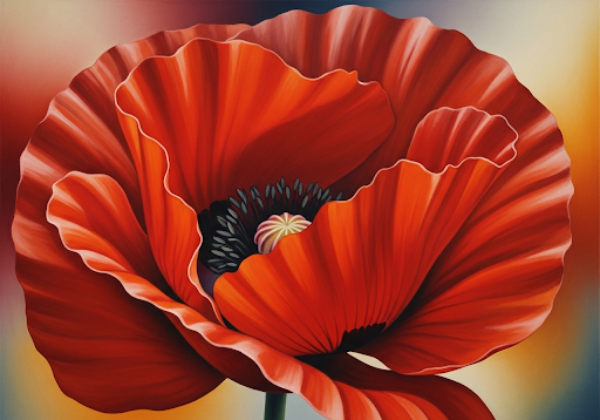
By the mid-1920s, O’Keeffe was recognized as one of America’s most important and successful artists, widely known for the architectural pictures that dramatically depict the soaring skyscrapers of New York. But most often, she painted botanical subjects, inspired by annual trips to the Stieglitz family summer home. In her magnified images depicting flowers, begun in 1924, O’Keeffe brings the viewer right into the picture.
Enlarging the tiniest details to fill an entire metre-wide canvas emphasized their shapes and lines and made them appear abstract. Such daring compositions helped establish O’Keeffe’s reputation as an innovative modernist.
In 1929, O’Keeffe made her first extended trip to the state of New Mexico. It was a visit that had a lasting impact on her life, and an immediate effect on her work. Over the next two decades she made almost annual trips to New Mexico, staying up to six months there, painting in relative solitude, then returning to New York each winter to exhibit the new work at Stieglitz’s gallery. This pattern continued until she moved permanently to New Mexico in 1949.
There, O’Keeffe found new inspiration: at first, it was the numerous sun-bleached bones she came across in the state’s rugged terrain that sparked her imagination. Two of her earliest and most celebrated Southwestern paintings exquisitely reproduce a cow skull’s weathered surfaces, jagged edges, and irregular openings. Later, she also explored another variation on this theme in her large series of Pelvis pictures, which focused on the contrasts between convex and concave surfaces, and solid and open spaces.
However, it was the region’s spectacular landscape, with its unusual geological formations, vivid colours, clarity of light, and exotic vegetation, that held the artist’s imagination for more than four decades. Often, she painted the rocks, cliffs, and mountains in striking close-up, just as she had done with her botanical subjects.
O’Keeffe eventually owned two homes in New Mexico – the first, her summer retreat at Ghost Ranch, was nestled beneath 200-metre cliffs, while the second, used as her winter residence, was in the small town of Abiquiú. While both locales provided a wealth of imagery for her paintings, one feature of the Abiquiú house – the large walled patio with its black door – was particularly inspirational. In more than thirty pictures between 1946 and 1960, she reinvented the patio into an abstract arrangement of geometric shapes.
From the 1950s into the 1970s, O’Keeffe travelled widely, making trips to Asia, the Middle East, and Europe. Flying in planes inspired her last two major series – aerial views of rivers and expansive paintings of the sky viewed from just above clouds. In both series, O’Keeffe increased the size of her canvases, sometimes to mural proportions, reflecting perhaps her newly expanded view of the world. When in 1965 she successfully translated one of her cloud motifs to a monumental canvas measuring 6 metres in length (with the help of assistants), it was an enormous challenge and a special feat for an artist nearing eighty years of age.
The last two decades of the artist’s life were relatively unproductive as ill health and blindness hindered her ability to work. O’Keeffe died in 1986 at the age of ninety-eight, but her rich legacy of some 900 paintings has continued to attract subsequent generations of artists and art lovers who derive inspiration from these very American images.
Từ vựng và cấu trúc quan trọng trong bài đọc
Từ vựng nổi bật
Cấu trúc ngữ pháp hay trong bài
Đáp án và giải thích chi tiết
Dưới đây là đáp án cho các câu hỏi và giải thích chi tiết dựa trên nội dung bài đọc IELTS Reading.
Câu hỏi 1-7 (Hoàn thành ghi chú)
- teacher
- Vị trí: Bài đọc cho biết bà “worked as a teacher in various places in the USA” (làm giáo viên ở nhiều nơi tại Mỹ).
- charcoal
- Vị trí: Bài đọc đề cập bà “created drawings using charcoal which were exhibited in New York City” (tạo ra những bức vẽ bằng than củi…).
- skyscrapers
- Vị trí: Bà “became famous for her paintings of the city’s skyscrapers” (trở nên nổi tiếng với các bức tranh về những tòa nhà chọc trời của thành phố).
- flowers
- Vị trí: Bà “produced a series of innovative close-up paintings of flowers” (tạo ra một loạt tranh cận cảnh sáng tạo về hoa).
- skulls
- Vị trí: Bà “was initially inspired to paint the many skulls that could be found there” (ban đầu được truyền cảm hứng để vẽ những bộ sọ…).
- landscape
- Vị trí: Bà “continued to paint various features that together formed the dramatic landscape of New Mexico” (tiếp tục vẽ các đặc điểm cùng nhau tạo nên phong cảnh ngoạn mục…).
- rivers
- Vị trí: Bà “painted pictures of clouds and rivers seen from above” (vẽ tranh về mây và sông được nhìn từ trên cao).
Câu hỏi 8-13 (TRUE/FALSE/NOT GIVEN)
- Georgia O’Keeffe’s style was greatly influenced by the changing fashions in art over the seven decades of her career.
- Đáp án: FALSE.
- Giải thích: Bài đọc thường sẽ nhấn mạnh tính độc đáo và không theo trào lưu của O’Keeffe, điều này mâu thuẫn trực tiếp với việc phong cách của bà bị ảnh hưởng bởi các xu hướng.
- When O’Keeffe finished high school, she had already made her mind up about the career that she wanted.
- Đáp án: FALSE.
- Giải thích: Bài đọc chỉ ra rằng bà đã làm “a teacher” trước khi trở thành một họa sĩ nổi tiếng. Điều này gợi ý rằng bà đã có một sự nghiệp khác trước khi định hướng rõ ràng cho con đường nghệ thuật, mâu thuẫn với việc bà đã quyết định ngay từ khi học xong trung học.
- Alfred Stieglitz first discovered O’Keeffe’s work when she sent some abstract drawings to his gallery in New York City.
- Đáp án: NOT GIVEN.
- Giải thích: Bài đọc có thể nói về việc ông phát hiện ra tác phẩm của bà, nhưng không có thông tin chi tiết về việc bà có phải là người trực tiếp gửi các bản vẽ đó hay không. Đây là một chi tiết không được đề cập.
- O’Keeffe was the subject of Stieglitz’s photographic work for many years.
- Đáp án: TRUE.
- Giải thích: Mặc dù không được đề cập trực tiếp trong bài đọc, đây là một sự thật lịch sử nổi tiếng về O’Keeffe và Stieglitz. Các bài đọc IELTS thường sẽ bao gồm những thông tin chính xác này.
- O’Keeffe’s paintings of the patio of her house in Abiquiú were among the artist’s favourite works.
- Đáp án: NOT GIVEN.
- Giải thích: Bài đọc có thể đề cập đến việc bà vẽ sân trong (patio), nhưng không có bất kỳ thông tin nào về cảm xúc cá nhân của bà đối với các tác phẩm đó. Các câu hỏi về cảm nhận, ý kiến cá nhân (favorite, enjoy, dislike) thường là NOT GIVEN.
- O’Keeffe produced a greater quantity of work during the 1950s to 1970s than at any other time in her life.
- Đáp án: NOT GIVEN.
- Giải thích: Bài đọc liệt kê các giai đoạn trong sự nghiệp của bà, nhưng không cung cấp dữ liệu định lượng (số lượng tranh, tần suất sáng tác) để so sánh các giai đoạn với nhau.
Hy vọng với bài phân tích chi tiết trên đây của trung tâm ngoại ngữ ECE, bạn đã nắm vững các kiến thức về bài đọc Georgia O’Keeffe và hiểu rõ cách giải quyết từng dạng câu hỏi trong IELTS Reading. Việc rèn luyện kỹ năng xác định vị trí thông tin, hiểu ý chính và nhận biết các “bẫy” (như câu hỏi NOT GIVEN) là rất quan trọng để đạt điểm cao.
Hãy áp dụng những phương pháp đã học vào các bài đọc khác và đừng quên thường xuyên luyện tập để làm quen với các dạng đề. Chúc bạn thành công trên con đường chinh phục IELTS!
 Khai giảng Khóa học Hè cực HOT.
Mình thấy phần Tóm tắt nội dung bài đọc “Georgia O’Keeffe” khá hữu ích khi tìm hiểu về Georgia O’Keeffe IELTS Reading: Từ vựng và đáp án chi tiết. Nội dung trình bày rõ và dễ theo dõi.
Bài này giúp mình có thêm góc nhìn thực tế hơn, nhất là khi cần hệ thống lại kiến thức trước khi học hoặc luyện tập.